
O granito é un tipo de rocha ígnea que se extrae pola súa extrema resistencia, densidade, durabilidade e resistencia á corrosión. Pero o granito tamén é moi versátil: non só serve para cadrados e rectángulos! De feito, traballamos con confianza con compoñentes de granito deseñados en formas, ángulos e curvas de todas as variacións de forma regular, con excelentes resultados.
Grazas ao noso procesamento de última xeración, as superficies cortadas poden ser excepcionalmente planas. Estas calidades fan do granito o material ideal para crear bases de máquinas e compoñentes de metroloxía de tamaño e deseño personalizados. O granito é:
■ mecanizable
■ precisamente plano unha vez cortado e rematado
■ resistente á ferruxe
■ duradeiro
■ de longa duración
Os compoñentes de granito tamén son fáciles de limpar. Ao crear deseños personalizados, asegúrate de escoller o granito polas súas vantaxes superiores.
ESTÁNDARES / APLICACIÓNS DE ALTO DESGASTE
O granito utilizado por ZHHIMG para os nosos produtos de placas de superficie estándar ten un alto contido de cuarzo, o que proporciona unha maior resistencia ao desgaste e aos danos. As nosas cores Superior Black teñen baixas taxas de absorción de auga, o que minimiza a posibilidade de que os seus calibres de precisión se oxiden ao colocalos nas placas. As cores de granito que ofrece ZHHIMG resultan en menos brillo, o que significa menos fatiga visual para as persoas que usan as placas. Escollemos os nosos tipos de granito tendo en conta a expansión térmica nun esforzo por manter este aspecto mínimo.
APLICACIÓNS PERSONALIZADAS
Cando a súa aplicación require unha placa con formas personalizadas, insercións roscadas, ranuras ou outros mecanizados, convén elixir un material como o negro Jinan. Este material natural ofrece unha rixidez superior, unha excelente amortiguación de vibracións e unha maquinabilidade mellorada.
É importante ter en conta que a cor por si soa non é un indicador das calidades físicas da pedra. En xeral, a cor do granito está directamente relacionada coa presenza ou ausencia de minerais, que poden non ter ningunha influencia nas calidades que fan que un bo material para placas superficiais sexa unha superficie. Hai granitos rosa, gris e negro que son excelentes para placas superficiais, así como granitos negros, grises e rosa que son totalmente inadecuados para aplicacións de precisión. As características críticas do granito, no que respecta ao seu uso como material para placas superficiais, non teñen nada que ver coa cor e son as seguintes:
■ Rixidez (deflexión baixo carga, indicada polo módulo de elasticidade)
■ Dureza
■ Densidade
■ Resistencia ao desgaste
■ Estabilidade
■ Porosidade
Probamos moitos materiais de granito e comparámolos. Finalmente, obtemos o resultado: o granito negro de Jinan é o mellor material que coñecemos. O granito negro indio e o granito surafricano son similares ao granito negro de Jinan, pero as súas propiedades físicas son inferiores ás do granito negro de Jinan. ZHHIMG seguirá buscando máis materiais de granito no mundo e comparando as súas propiedades físicas.
Para falar máis sobre o granito axeitado para o seu proxecto, póñase en contacto connosco.info@zhhimg.com.
Os diferentes fabricantes empregan diferentes estándares. Hai moitos estándares no mundo.
Norma DIN, ASME B89.3.7-2013 ou Especificación Federal GGG-P-463c (Placas Superficiais de Granito) e así sucesivamente como base para as súas especificacións.
E podemos fabricar placas de inspección de precisión de granito segundo as súas necesidades. Póñase en contacto connosco se desexa obter máis información sobre máis estándares.
A planitude pódese considerar como todos os puntos da superficie contidos dentro de dous planos paralelos, o plano base e o plano do tellado. A medida da distancia entre os planos é a planitude xeral da superficie. Esta medida de planitude adoita ter unha tolerancia e pode incluír unha designación de grao.
Por exemplo, as tolerancias de planitude para tres graos estándar defínense na especificación federal segundo a seguinte fórmula:
■ AA de grao de laboratorio = (40 + diagonal ao cadrado/25) x 0,000001" (unilateral)
■ Grao de inspección A = Grao de laboratorio AA x 2
■ Sala de ferramentas Grao B = Laboratorio Grao AA x 4.
Para placas de superficie de tamaño estándar, garantimos tolerancias de planitude que superan os requisitos desta especificación. Ademais da planitude, a norma ASME B89.3.7-2013 e a especificación federal GGG-P-463c abordan temas como: precisión de medición repetida, propiedades dos materiais dos granitos das placas de superficie, acabado superficial, localización dos puntos de apoio, rixidez, métodos de inspección aceptables, instalación de insercións roscadas, etc.
As placas de superficie de granito ZHHIMG e as placas de inspección de granito cumpren ou superan todos os requisitos establecidos nesta especificación. Na actualidade, non existe unha especificación definitoria para placas angulares, paralelas ou escuadras mestras de granito.
E podes atopar as fórmulas para outros estándares enDESCARGAR.
En primeiro lugar, é importante manter a placa limpa. O po abrasivo transportado polo aire adoita ser a maior fonte de desgaste dunha placa, xa que tende a incrustarse nas pezas de traballo e nas superficies de contacto dos calibres. En segundo lugar, cubra a placa para protexela do po e dos danos. A vida útil pódese prolongar cubrindo a placa cando non se use, xirándoa periodicamente para que unha soa área non reciba un uso excesivo e substituíndo as almofadas de contacto de aceiro nos calibres por almofadas de carburo. Ademais, evite colocar alimentos ou refrescos na placa. Teña en conta que moitos refrescos conteñen ácido carbónico ou fosfórico, que pode disolver os minerais máis brandos e deixar pequenos buratos na superficie.
Isto depende de como se utilice a placa. Se é posible, recomendamos limpala ao comezo do día (ou da quenda de traballo) e de novo ao final. Se a placa se ensucia, especialmente con fluídos oleosos ou pegañentos, probablemente debería limparse inmediatamente.
Limpar a placa regularmente con líquido ou cun limpador de placas de superficie sen auga ZHHIMG. A elección das solucións de limpeza é importante. Se se usa un disolvente volátil (acetona, diluínte de laca, alcol, etc.), a evaporación arrefriará a superficie e distorsionaraa. Neste caso, é necesario deixar que a placa se normalice antes de usala ou produciranse erros de medición.
O tempo que tarda a placa en normalizarse variará segundo o seu tamaño e a cantidade de arrefriamento. Unha hora debería ser suficiente para placas máis pequenas. Poden ser necesarias dúas horas para placas máis grandes. Se se usa un limpador a base de auga, tamén haberá certo arrefriamento por evaporación.
A placa tamén reterá a auga, e isto podería causar oxidación nas pezas metálicas en contacto coa superficie. Algúns produtos de limpeza tamén deixarán un residuo pegañento despois de secar, o que atraerá o po no aire e, de feito, aumentará o desgaste, en lugar de reducilo.
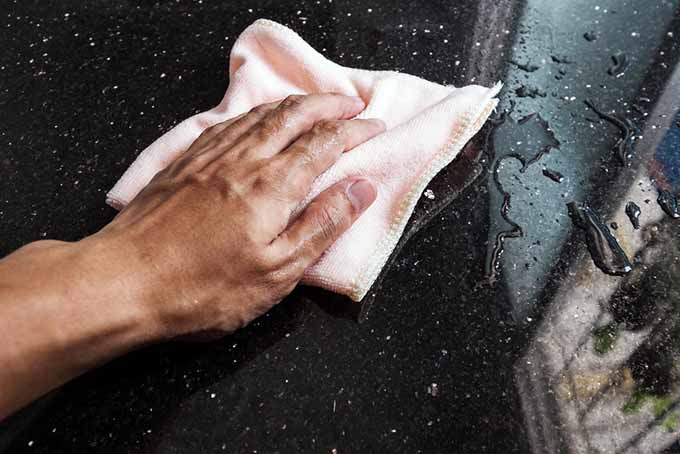
Isto depende do uso da placa e do ambiente. Recomendamos que unha placa nova ou un accesorio de granito de precisión reciba unha recalibración completa nun prazo dun ano desde a súa compra. Se a placa de granito vai sufrir un uso intensivo, pode ser aconsellable acurtar este intervalo a seis meses. A inspección mensual para detectar erros de medición repetidos cun nivel electrónico ou un dispositivo similar mostrará calquera punto de desgaste en desenvolvemento e só leva uns minutos realizarse. Unha vez determinados os resultados da primeira recalibración, o intervalo de calibración pode ampliarse ou acurtarse segundo o permita ou o requira o seu sistema de calidade interno.
Podemos ofrecerche un servizo para axudarche a inspeccionar e calibrar a túa placa de superficie de granito.

Hai varias posibles causas para as variacións entre calibracións:
- A superficie lavouse cunha solución quente ou fría antes da calibración e non se lle deu tempo suficiente para normalizarse.
- A placa está mal apoiada
- Cambio de temperatura
- Borradores
- Luz solar directa ou outra calor radiante na superficie do prato. Asegúrate de que a iluminación superior non quente a superficie.
- Variacións no gradiente de temperatura vertical entre o inverno e o verán (se é posible, coñeza a temperatura do gradiente vertical no momento en que se realiza a calibración).
- A placa non ten tempo suficiente para normalizarse despois do envío
- Uso inadecuado de equipos de inspección ou uso de equipos non calibrados
- Cambios superficiais derivados do desgaste
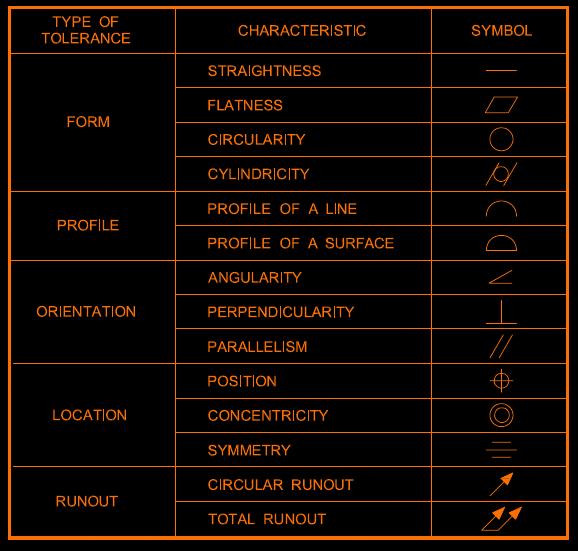
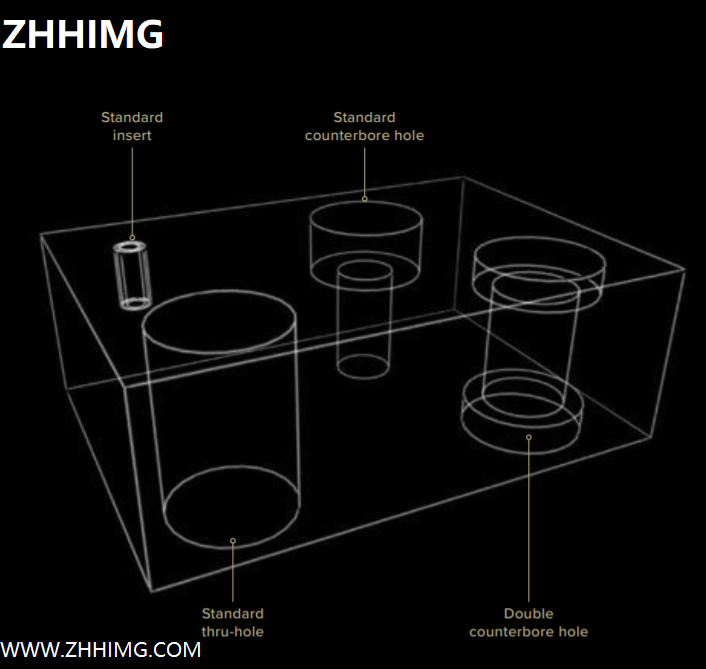
Cantos tipos de buratos hai no granito de precisión?
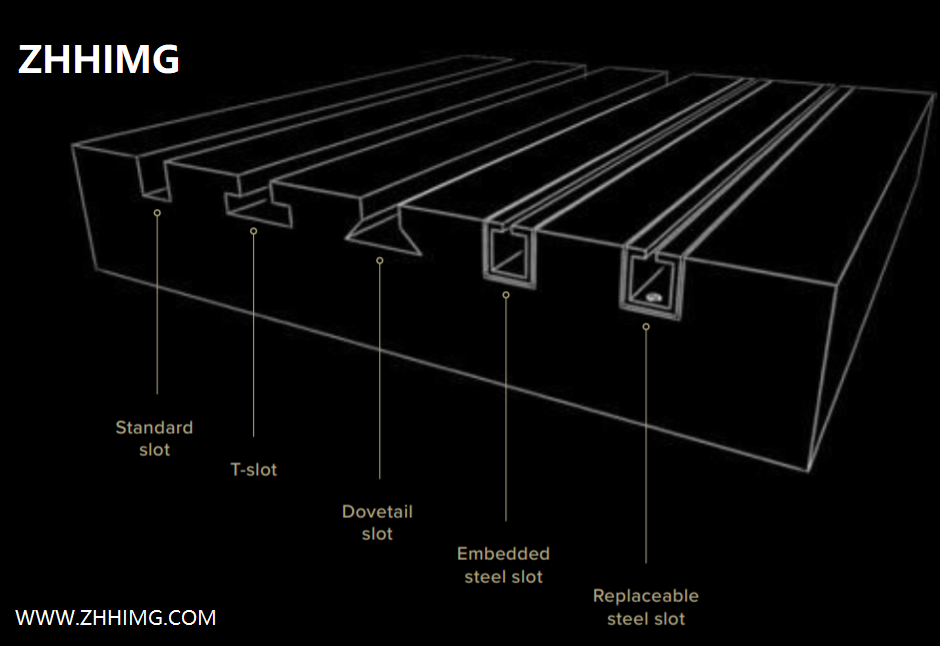
Ranuras en compoñentes de granito de precisión
Moitas fábricas, salas de inspección e laboratorios empregan placas de superficie de granito de precisión como base para medicións precisas. Dado que cada medición lineal depende dunha superficie de referencia precisa da que se toman as dimensións finais, as placas de superficie proporcionan o mellor plano de referencia para a inspección e o deseño do traballo antes do mecanizado. Tamén son bases ideais para realizar medicións de altura e superficies de calibración. Ademais, o seu alto grao de planitude, estabilidade, calidade xeral e man de obra convértenas nunha boa opción para montar sistemas de calibración mecánicos, electrónicos e ópticos sofisticados. Para calquera destes procesos de medición, é imprescindible manter as placas de superficie calibradas.
Repetir medicións e planitude
Tanto a planaridade como as medicións repetidas son fundamentais para garantir unha superficie precisa. A planaridade pódese considerar como todos os puntos da superficie contidos dentro de dous planos paralelos, o plano base e o plano do tellado. A medición da distancia entre os planos é a planaridade xeral da superficie. Esta medición de planaridade adoita ter unha tolerancia e pode incluír unha designación de grao.
As tolerancias de planitude para tres graos estándar defínense na especificación federal segundo a seguinte fórmula:
Estándar DIN, estándar GB, estándar ASME, estándar JJS... diferentes países con diferentes soportes...
Máis detalles sobre o estándar.
Ademais da planitude, débese garantir a repetibilidade. Unha medición repetida é unha medición de áreas de planitude locais. É unha medición tomada en calquera lugar da superficie dunha placa que se repetirá dentro da tolerancia indicada. Controlar a planitude da área local cunha tolerancia máis axustada que a planitude xeral garante un cambio gradual no perfil de planitude da superficie, minimizando así os erros locais.
Para garantir que unha placa de superficie cumpra as especificacións de planitude e repetición de medicións, os fabricantes de placas de superficie de granito deben usar a especificación federal GGG-P-463c como base para as súas especificacións. Esta norma aborda a precisión da repetición de medicións, as propiedades do material do granito das placas de superficie, o acabado superficial, a localización do punto de apoio, a rixidez, os métodos aceptables de inspección e a instalación de insercións roscadas.
Comprobación da precisión da placa
Seguindo unhas cantas pautas sinxelas, un investimento nunha placa de superficie de granito debería durar moitos anos. Dependendo do uso da placa, do ambiente do taller e da precisión requirida, a frecuencia de comprobación da precisión da placa de superficie varía. Unha regra xeral é que unha placa nova reciba unha recalibración completa nun prazo dun ano desde a súa compra. Se a placa se usa con frecuencia, é aconsellable acurtar este intervalo a seis meses.
Antes de que unha placa de superficie se desgaste máis alá das especificacións de planitude xeral, mostrará postes desgastados ou ondulados. A inspección mensual para detectar erros de medición repetida cun calibre de lectura repetida identificará os puntos de desgaste. Un calibre de lectura repetida é un instrumento de alta precisión que detecta erros locais e pode visualizarse nun amplificador electrónico de gran aumento.
Un programa de inspección eficaz debería incluír comprobacións regulares cun autocolimador, que proporcionen unha calibración real da planitude xeral rastrexable ao Instituto Nacional de Estándares e Tecnoloxía (NIST). De cando en vez é necesaria unha calibración exhaustiva por parte do fabricante ou dunha empresa independente.
Variacións entre calibracións
Nalgúns casos, existen variacións entre as calibracións das placas de superficie. Ás veces, factores como o cambio na superficie resultante do desgaste, o uso incorrecto do equipo de inspección ou o uso de equipo non calibrado poden explicar estas variacións. Non obstante, os dous factores máis comúns son a temperatura e o soporte.
Unha das variables máis importantes é a temperatura. Por exemplo, a superficie pode terse lavado cunha solución quente ou fría antes da calibración e non se lle deu tempo suficiente para normalizarse. Outras causas de cambio de temperatura inclúen correntes de aire frío ou quente, luz solar directa, iluminación superior ou outras fontes de calor radiante na superficie da placa.
Tamén pode haber variacións no gradiente de temperatura vertical entre o inverno e o verán. Nalgúns casos, a placa non ten tempo suficiente para normalizarse despois do envío. É unha boa idea rexistrar a temperatura do gradiente vertical no momento en que se realiza a calibración.
Outra causa común de variación na calibración é unha placa que non está soportada correctamente. Unha placa de superficie debe estar soportada en tres puntos, idealmente situados ao 20 % da lonxitude cara a dentro desde os extremos da placa. Dous soportes deben estar situados ao 20 % da anchura cara a dentro desde os lados longos e o soporte restante debe estar centrado.
Só tres puntos poden descansar solidamente sobre calquera superficie que non sexa de precisión. Se intentas soportar a placa en máis de tres puntos, esta recibirá o seu soporte de varias combinacións de tres puntos, que non serán os mesmos tres puntos nos que se apoiou durante a produción. Isto introducirá erros a medida que a placa se desvía para adaptarse á nova disposición de soporte. Considere o uso de soportes de aceiro con vigas de soporte deseñadas para aliñarse cos puntos de soporte axeitados. Os soportes para este propósito adoitan estar dispoñibles a través do fabricante da placa de superficie.
Se a placa está correctamente soportada, a nivelación precisa só é necesaria se unha aplicación o especifica. A nivelación non é necesaria para manter a precisión dunha placa correctamente soportada.
Prolongar a vida útil da placa
Seguir unhas cantas pautas reducirá o desgaste dunha placa de granito e, en definitiva, prolongará a súa vida útil.
En primeiro lugar, é importante manter a placa limpa. O po abrasivo transportado polo aire adoita ser a maior fonte de desgaste dunha placa, xa que tende a incrustarse nas pezas de traballo e nas superficies de contacto dos calibres.
Tamén é importante cubrir as placas para protexelas do po e dos danos. A súa vida útil pódese prolongar cubrindo a placa cando non se usa.
Xire a placa periodicamente para que unha soa área non reciba un uso excesivo. Ademais, recoméndase substituír as almofadas de contacto de aceiro nas medicións por almofadas de carburo.
Evita poñer comida ou refrescos no prato. Moitos refrescos conteñen ácido carbónico ou fosfórico, que pode disolver os minerais máis brandos e deixar pequenos buratos na superficie.
Onde recaer
Cando sexa necesario rectificar a superficie dunha placa de granito, considere se se debe realizar este servizo in situ ou nas instalacións de calibración. Sempre é preferible rectificar a superficie da placa na fábrica ou nunha instalación específica. Non obstante, se a placa non está demasiado desgastada, xeralmente dentro de 0,001 polgadas da tolerancia requirida, pódese rectificar a superficie in situ. Se unha placa está desgastada ata o punto de estar máis de 0,001 polgadas fóra da tolerancia, ou se está moi danada ou rabuñada, debe enviarse á fábrica para a súa rectificación antes de rectificala.
Unha instalación de calibración ten o equipo e a configuración de fábrica que proporcionan as condicións óptimas para a calibración axeitada da placa e o retraballo se é necesario.
Débese ter moito coidado á hora de escoller un técnico de calibración e repavimentación in situ. Solicite a acreditación e verifique que o equipo que empregará o técnico teña unha calibración rastrexable. A experiencia tamén é un factor importante, xa que leva moitos anos aprender a lapear correctamente granito de precisión.
As medicións críticas comezan cunha placa de superficie de granito de precisión como liña de base. Ao garantir unha referencia fiable mediante o uso dunha placa de superficie calibrada correctamente, os fabricantes dispoñen dunha das ferramentas esenciais para realizar medicións fiables e obter pezas de mellor calidade.Q
Lista de verificación para as variacións de calibración
1. A superficie lavouse cunha solución quente ou fría antes da calibración e non se lle deu tempo suficiente para normalizarse.
2. A placa non está ben apoiada.
3. Cambio de temperatura.
4. Borradores.
5. Luz solar directa ou outra calor radiante na superficie da placa. Asegúrate de que a iluminación superior non quente a superficie.
6. Variacións no gradiente vertical de temperatura entre o inverno e o verán. Se é posible, coñeza a temperatura do gradiente vertical no momento en que se realiza a calibración.
7. Non se lle concedeu á placa tempo suficiente para normalizarse despois do envío.
8. Uso inadecuado do equipo de inspección ou uso de equipo non calibrado.
9. Cambio superficial resultante do desgaste.
Consellos técnicos
- Dado que cada medición lineal depende dunha superficie de referencia precisa da que se toman as dimensións finais, as placas de superficie proporcionan o mellor plano de referencia para a inspección do traballo e o deseño antes do mecanizado.
- Controlar a planitude da área local cunha tolerancia máis axustada que a planitude xeral garante un cambio gradual no perfil de planitude da superficie, minimizando así os erros locais.
- Un programa de inspección eficaz debería incluír comprobacións regulares cun autocolimador, que proporcionen unha calibración real da planitude xeral rastrexable ata a Autoridade Nacional de Inspección.
Entre as partículas minerais que compoñen o granito, máis do 90 % son feldespato e cuarzo, dos cales o feldespato é o máis abundante. O feldespato adoita ser branco, gris e vermello carne, e o cuarzo é maioritariamente incoloro ou branco agrisado, que constitúen a cor básica do granito. O feldespato e o cuarzo son minerais duros e é difícil movelos cun coitelo de aceiro. En canto ás manchas escuras no granito, principalmente mica negra, hai algúns outros minerais. Aínda que a biotita é relativamente branda, a súa capacidade para resistir a tensión non é débil e, ao mesmo tempo, teñen unha pequena cantidade no granito, a miúdo inferior ao 10 %. Esta é a condición material na que o granito é particularmente forte.
Outra razón pola que o granito é forte é que as súas partículas minerais están fortemente unidas entre si e incrustadas unhas nas outras. Os poros adoitan representar menos do 1 % do volume total da rocha. Isto dálle ao granito a capacidade de soportar fortes presións e non é facilmente penetrado pola humidade.
Os compoñentes de granito están feitos de pedra sen resistencia á ferruxe, aos ácidos e aos álcalis, boa resistencia ao desgaste e longa vida útil, sen mantemento especial. Os compoñentes de precisión de granito úsanse principalmente na ferramenta da industria da maquinaria. Polo tanto, denomínanse compoñentes de precisión de granito ou compoñentes de granito. As características dos compoñentes de precisión de granito son basicamente as mesmas que as das plataformas de granito. Introdución á ferramenta e medición de compoñentes de precisión de granito: a mecanización de precisión e a tecnoloxía de micromecanización son importantes direccións de desenvolvemento da industria de fabricación de maquinaria e convertéronse nun indicador importante para medir un nivel de alta tecnoloxía. O desenvolvemento de tecnoloxía de vangarda e a industria da defensa son inseparables da mecanización de precisión e a tecnoloxía de micromecanización. Os compoñentes de granito pódense deslizar suavemente na medición, sen estancamento. A medición da superficie de traballo, os arañazos xerais non afectan a precisión da medición. Os compoñentes de granito deben deseñar e producirse segundo os requisitos da demanda.
Campo de aplicación:
Como todos sabemos, cada vez máis máquinas e equipos escollen compoñentes de granito de precisión.
Os compoñentes de granito utilízanse para movemento dinámico, motores lineais, CMM, CNC, máquina láser...
Póñase en contacto connosco para obter máis información.
Os dispositivos de medición de granito e os compoñentes mecánicos de granito están feitos de granito negro de Jinan de alta calidade. Debido á súa alta precisión, longa duración, boa estabilidade e resistencia á corrosión, utilízanse cada vez máis na inspección de produtos da industria moderna e en áreas científicas como a mecánica aeroespacial e as investigacións científicas.
Vantaxes
----Dúas veces máis duro que o ferro fundido;
----Os cambios mínimos de dimensión débense aos cambios de temperatura;
---- Libre de espremer, polo que non hai interrupción do traballo;
---- Libre de rebabas ou protuberancias debido á estrutura de gran fino e á adherencia insignificante, o que garante un alto grao de planitude durante unha longa vida útil e non causa danos a outras pezas ou instrumentos;
---- Funcionamento sen problemas para o seu uso con materiais magnéticos;
----Longa vida útil e sen ferruxe, o que resulta en baixos custos de mantemento.
As placas de precisión de granito están lapeadas con precisión cun alto estándar de planitude para lograr a precisión e utilízanse como base para montar sofisticados sistemas de medición mecánicos, electrónicos e ópticos.
Algunhas das características únicas da placa de superficie de granito:
Uniformidade na dureza;
Preciso baixo condicións de carga;
Absorbente de vibracións;
Fácil de limpar;
Resistente á envoltura;
Baixa porosidade;
Non abrasivo;
Non magnético
Vantaxes da placa de superficie de granito
En primeiro lugar, a rocha despois dun longo período de envellecemento natural, estrutura uniforme, coeficiente mínimo, a tensión interna desaparece por completo, non se deforma, polo que a precisión é alta.
En segundo lugar, non haberá arañazos, non en condicións de temperatura constantes, a temperatura ambiente tamén pode manter a precisión da medición da temperatura.
En terceiro lugar, sen magnetización, a medición pode ser un movemento suave, sen sensación de chirrido, non se ve afectada pola humidade, o plano é fixo.
Catro, a rixidez é boa, a dureza é alta e a resistencia á abrasión é forte.
Cinco, sen medo á erosión do ácido e dos líquidos alcalinos, non se oxida, non ten que pintar con aceite, non é doado que se pegue o micropo, mantemento, fácil de manter, longa vida útil.
Por que elixir unha base de granito en lugar dunha bancada de máquina de ferro fundido?
1. A base da máquina de granito pode manter unha maior precisión que a base da máquina de ferro fundido. A base da máquina de ferro fundido é facilmente afectada pola temperatura e a humidade, pero a base da máquina de granito non;
2. Co mesmo tamaño da base da máquina de granito e da base de ferro fundido, a base da máquina de granito é máis rendible que a de ferro fundido;
3. A base especial da máquina de granito é máis fácil de rematar que a base da máquina de ferro fundido.
As placas de superficie de granito son instrumentos clave nos laboratorios de inspección de todo o país. A superficie calibrada e extremadamente plana dunha placa de superficie permite aos inspectores usalas como liña de base para as inspeccións de pezas e a calibración de instrumentos. Sen a estabilidade que ofrecen as placas de superficie, moitas das pezas con tolerancias estritas en varios campos tecnolóxicos e médicos serían moito máis difíciles, se non imposibles, de fabricar correctamente. Por suposto, para usar un bloque de superficie de granito para calibrar e inspeccionar outros materiais e ferramentas, débese avaliar a precisión do propio granito. Os usuarios poden calibrar unha placa de superficie de granito para garantir a súa precisión.
Limpa a placa de superficie de granito antes da calibración. Verte unha pequena cantidade de limpador de placas de superficie nun pano limpo e suave e limpa a superficie do granito. Seca inmediatamente o limpador da placa de superficie cun pano seco. Non deixes que o líquido de limpeza seque ao aire.
Coloque un calibre de medición repetida no centro da placa de superficie de granito.
Axusta o calibre de medición repetida á superficie da placa de granito.
Move o medidor lentamente pola superficie do granito. Observa o indicador do medidor e rexistra os picos de calquera variación de altura mentres moves o instrumento pola placa.
Compara a variación de planitude na superficie da placa coas tolerancias da túa placa de superficie, que varían segundo o tamaño da placa e o grao de planitude do granito. Consulta a especificación federal GGG-P-463c (consulta Recursos) para determinar se a túa placa cumpre os requisitos de planitude para o seu tamaño e grao. A variación entre o punto máis alto da placa e o punto máis baixo da placa é a súa medida de planitude.
Comprobe que as maiores variacións de profundidade na superficie da placa estean dentro das especificacións de repetibilidade para unha placa dese tamaño e grao. Consulte a especificación federal GGG-P-463c (consulte Recursos) para determinar se a súa placa cumpre os requisitos de repetibilidade para o seu tamaño. Rexeite a placa de superficie se mesmo un só punto non cumpre os requisitos de repetibilidade.
Deixa de usar unha placa de granito que non cumpra os requisitos federais. Devolve a placa ao fabricante ou a unha empresa de superficies de granito para que o bloque sexa pulido de novo para que cumpra as especificacións.
Consello
Realice calibracións formais polo menos unha vez ao ano, aínda que as placas de granito que reciben un uso intensivo deberían calibrarse con máis frecuencia.
A calibración formal e rexistrable en contornas de fabricación ou inspección adoita ser realizada por un equipo de control de calidade ou por un provedor externo de servizos de calibración, aínda que calquera pode usar un calibre de medición repetida para comprobar informalmente unha placa de superficie antes do seu uso.
A historia temperá das placas superficiais de granito
Antes da Segunda Guerra Mundial, os fabricantes empregaban placas de aceiro para a inspección dimensional das pezas. Durante a Segunda Guerra Mundial, a necesidade de aceiro aumentou drasticamente e fundíronse moitas placas de aceiro. Foi necesaria unha substitución e o granito converteuse no material elixido debido ás súas propiedades metrolóxicas superiores.
Fixéronse evidentes varias vantaxes do granito sobre o aceiro. O granito é máis duro, aínda que máis fráxil e propenso a lascas. Pódese lapear o granito ata obter unha planitude moito maior e máis rápido que o aceiro. O granito tamén ten a propiedade desexable dunha menor expansión térmica en comparación co aceiro. Ademais, se unha placa de aceiro necesitaba reparación, tiña que ser raspada a man por artesáns que tamén aplicaban as súas habilidades na reconstrución de máquinas-ferramenta.
Como nota ao marxe, algunhas placas de superficie de aceiro aínda se usan hoxe en día.
Propiedades metrolóxicas das placas de granito
O granito é unha rocha ígnea formada por erupcións volcánicas. En comparación, o mármore é calcaria metamorfizada. Para o seu uso en metroloxía, o granito seleccionado debe cumprir os requisitos específicos descritos na Especificación Federal GGG-P-463c, de agora en diante chamada Fed Specs, e especificamente, a Parte 3.1 3.1 Entre as Fed Specs, o granito debe ter unha textura de gran fino a medio.
O granito é un material duro, pero a súa dureza varía por varias razóns. Un técnico experimentado en placas de granito pode estimar a dureza pola súa cor, que é unha indicación do seu contido de cuarzo. A dureza do granito é unha propiedade definida en parte pola cantidade de contido de cuarzo e a falta de mica. Os granitos vermello e rosa tenden a ser os máis duros, os grises teñen unha dureza media e os negros son os máis brandos.
O módulo de elasticidade de Young úsase para expresar a flexibilidade ou a indicación da dureza da pedra. O granito rosa ten unha media de 3 a 5 puntos na escala, os grises de 5 a 7 puntos e os negros de 7 a 10 puntos. Canto menor sexa o número, máis duro tende a ser o granito. Canto maior sexa o número, máis brando e flexible será o granito. É importante coñecer a dureza do granito ao elixir o grosor necesario para os graos de tolerancia e o peso das pezas e os calibres que se colocan sobre el.
Antigamente, cando había maquinistas de verdade, coñecidos polos seus folletos de táboa trigonométrica nos petos das camisas, o granito negro considerábase "o mellor". O mellor definíase como o tipo que ofrecía maior resistencia ao desgaste ou que era máis duro. Un inconveniente é que os granitos máis duros tenden a lascarse ou abollarse con máis facilidade. Os maquinistas estaban tan convencidos de que o granito negro era o mellor que algúns fabricantes de granito rosa tinguíronos de negro.
Eu mesmo vin unha placa que caeu dunha carretilla elevadora cando a sacaban do almacén. A placa golpeou o chan e partiuse en dous, revelando a verdadeira cor rosa. Teña coidado se planea mercar granito negro fóra da China. Recomendámoslle que malgaste o seu diñeiro doutro xeito. Unha placa de granito pode variar en dureza dentro de si mesma. Unha veta de cuarzo pode ser moito máis dura que o resto da placa superficial. Unha capa de gabro negro pode facer que unha zona sexa moito máis branda. Un técnico de reparación de placas superficiais ben adestrado e con experiencia sabe como manexar estas zonas brandas.
Graos da placa superficial
Hai catro graos de placas de superficie. Grao de laboratorio AA e A, Grao de inspección de sala B e o cuarto é Grao de taller. Os graos AA e A son os máis planos, cunha tolerancia de planitude mellor que 0,00001 polgadas para unha placa de Grao AA. Os graos de taller son os menos planos e, como o seu nome indica, están destinados ao seu uso en salas de ferramentas. Mentres que os graos AA, A e B están destinados ao seu uso nun laboratorio de inspección ou control de calidade.
PProbas de cordaxe para a calibración da placa de superficie
Sempre lles dixen aos meus clientes que podo sacar a calquera neno de 10 anos da miña igrexa e ensinarlle en só uns días como probar unha placa. Non é difícil. Require algo de técnica para realizar a tarefa rapidamente, técnicas que se aprenden co tempo e moita repetición. Debo informarvos, e non podo enfatizar o suficiente, que o Fed Spec GGG-P-463c NON É un procedemento de calibración! Máis sobre iso máis tarde.
A calibración da planitude xeral (panel medio) e as comprobacións de repetibilidade (desgaste localizado) son imprescindibles segundo as especificacións federais. A única excepción a isto son as placas pequenas, onde só se require repetibilidade.
Tamén, e tan fundamental como as outras probas, é a proba dos gradientes térmicos. (Vexa Delta T a continuación)
Figura 1
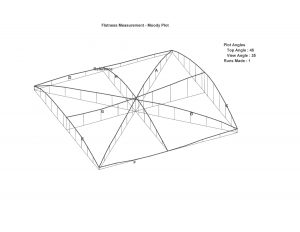
As probas de planitude teñen 4 métodos aprobados. niveis electrónicos, autocolimación, láser e un dispositivo coñecido como localizador de planos. Só empregamos niveis electrónicos porque son o método máis preciso e rápido por varias razóns.
Os láseres e os autocolimadores usan un feixe de luz moi recto como referencia. Unha medida de rectitude dunha placa de granito realízase comparando a variación de distancia entre a placa de granito e o feixe de luz. Ao tomar un feixe de luz recto e incidilo nun obxectivo reflector mentres se move o obxectivo reflector cara abaixo pola placa de granito, a distancia entre o feixe emitido e o feixe de retorno é unha medida de rectitude.
Aquí está o problema con este método. O obxectivo e a fonte vense afectados pola vibración, a temperatura ambiente, un obxectivo pouco plano ou raiado, a contaminación no aire e o movemento do aire (correntes). Todo isto contribúe a compoñentes adicionais de erro. Ademais, a contribución do erro do operador das comprobacións cun autocolimador é maior.
Un usuario experimentado de autocolimadores pode facer medicións moi precisas, pero aínda ten problemas coa consistencia das lecturas, especialmente a distancias longas, xa que os reflexos tenden a ampliarse ou a volverse lixeiramente borrosos. Ademais, un obxectivo non perfectamente plano e un longo día mirando a través da lente producen erros adicionais.
Un dispositivo localizador de planos é unha parvada. Este dispositivo usa un raio de luz algo recto (en comparación cun raio de luz colimado ou láser extremadamente recto) como referencia. O dispositivo mecánico non só usa un indicador que normalmente ten unha resolución de só 20 polgadas, senón que a falta de rectitude da barra e os materiais disímiles aumentan significativamente os erros de medición. Na nosa opinión, aínda que o método é aceptable, ningún laboratorio competente usaría xamais un dispositivo localizador de planos como instrumento de inspección final.
Os niveis electrónicos usan a gravidade como referencia. Os niveis electrónicos diferenciais non se ven afectados pola vibración. Teñen unha resolución tan baixa como 0,1 segundo de arco e as medicións son rápidas e precisas, e hai moi pouca contribución de erro por parte dun operador experimentado. Nin os localizadores de planos nin os autocolimadores proporcionan gráficos topográficos (Figura 1) ou isométricos (Figura 2) da superficie xerados por ordenador.
Figura 2
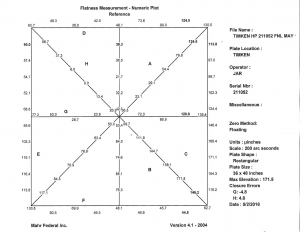
Unha proba de planitude axeitada da superficie
Unha proba de planitude axeitada da superficie é unha parte tan importante deste traballo que debería tela colocado ao principio. Como se indicou anteriormente, a especificación federal GGG-p-463c NON é un método de calibración. Serve como guía para moitos aspectos do granito de grao metrolóxico cuxo comprador previsto é calquera axencia do goberno federal, e iso inclúe os métodos de proba e as tolerancias ou graos. Se un contratista afirma que cumpriu as especificacións federais, o valor de planitude determinarase mediante o método Moody.
Moody era un tipo de alá polos anos 50 que ideou un método matemático para determinar a planitude xeral e ter en conta a orientación das liñas probadas, se estaban suficientemente preto no mesmo plano. Nada cambiou. Allied Signal intentou mellorar o método matemático, pero chegou á conclusión de que as diferenzas eran tan pequenas que non valía a pena o esforzo.
Se un contratista de placas de superficie usa niveis electrónicos ou láser, usa un ordenador para axudalo cos cálculos. Sen axuda informática, o técnico que usa a autocolimación debe calcular as lecturas a man. En realidade, non o fan. Leva demasiado tempo e, francamente, pode ser demasiado difícil. Nunha proba de planitude usando o método Moody, o técnico comproba a rectitude de oito liñas nunha configuración de Union Jack.
O método Moody
O método Moody é unha forma matemática de determinar se as oito liñas están no mesmo plano. Se non, só tes 8 liñas rectas que poden ou non estar no mesmo plano ou preto del. Ademais, un contratista que afirma cumprir as especificacións federais e usa a autocolimación,debexerar oito páxinas de datos. Unha páxina para cada liña comprobada para demostrar as súas probas, reparacións ou ambas. Se non, o contratista non ten nin idea de cal é o valor real de planitude.
Estou seguro de que se es un deses que fai calibrar as súas placas por un contratista usando autocolimación, nunca viches esas páxinas! A figura 3 é un exemplo desó unpáxina de oito necesarias para calcular a planitude xeral. Un indicador desa ignorancia e malicia é se o teu informe ten números redondeados. Por exemplo, 200, 400, 650, etc. Un valor calculado correctamente é un número real. Por exemplo, 325,4 u In. Cando o contratista usa o método de cálculos Moody e o técnico calcula os valores manualmente, deberías recibir oito páxinas de cálculos e un gráfico isométrico. O gráfico isométrico mostra as alturas variables ao longo das diferentes liñas e canta distancia separa os puntos de intersección seleccionados.
Figura 3(Calcular a planitude manualmente leva oito páxinas coma esta. Asegúrate de preguntar por que non obtés isto se o teu contratista usa autocolimación!)
Figura 4
Os técnicos de calibre dimensional empregan niveis diferenciais (Figura 4) como dispositivos preferidos para medir os cambios mínimos na angularidade dunha estación de medición a outra. Os niveis teñen unha resolución de ata 0,1 segundos de arco (5 polgadas de µ usando un trineo de 4″), son extremadamente estables e non se ven afectados pola vibración, as distancias medidas, as correntes de aire, a fatiga do operador, a contaminación do aire ou calquera dos problemas inherentes a outros dispositivos. Engádelle a asistencia do ordenador e a tarefa faise relativamente rápida, xerando gráficos topográficos e isométricos que proban a verificación e, o máis importante, a reparación.
Unha proba de repetibilidade axeitada
A lectura repetida ou repetibilidade é a proba máis importante. O equipo que empregamos para realizar a proba de repetibilidade é un dispositivo de lectura repetida, un LVDT e un amplificador necesario para lecturas de alta resolución. Axustamos o amplificador LVDT a unha resolución mínima de 10 µ polgadas ou 5 µ polgadas para placas de alta precisión.
Empregar un indicador mecánico cunha resolución de só 20 polgadas µ non serve de nada se se está a tentar comprobar un requisito de repetibilidade de 35 polgadas µ. Os indicadores teñen unha incerteza de 40 polgadas µ! A configuración de lectura repetida imita unha configuración de peza/calibre de altura.
A repetibilidade NON É o mesmo que a planitude xeral (plano medio). Gústame pensar na repetibilidade no granito vista como unha medida de radio consistente.
Figura 5
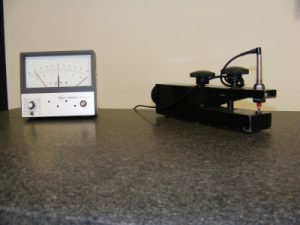
Se probas a repetibilidade dunha bóla redonda, entón demostras que o raio da bóla non cambiou. (O perfil ideal dunha placa reparada correctamente ten unha forma coroada convexa). Non obstante, é evidente que a bóla non é plana. Ben, máis ou menos. Nunha distancia extremadamente curta, é plana. Dado que a maioría dos traballos de inspección implican un calibre de altura moi preto da peza, a repetibilidade convértese na propiedade máis crítica dunha placa de granito. É máis importante que a planitude xeral a menos que un usuario estea a comprobar a rectitude dunha peza longa.
Asegúrate de que o teu contratista realice unha proba de lectura repetida. Unha placa pode ter unha lectura repetida significativamente fóra da tolerancia pero aínda así superar unha proba de planitude! Sorprendentemente, un laboratorio pode obter acreditación en probas que non inclúen unha proba de lectura repetida. Un laboratorio que non pode reparar ou non é moi bo reparando prefire realizar só probas de planitude. A planitude raramente cambia a menos que movas a placa.
A proba de lectura repetida é a máis doada de comprobar pero a máis difícil de conseguir ao lapear. Asegúrate de que o teu contratista poida restaurar a repetibilidade sen "esnaquizar" a superficie nin deixar ondas nela.
Proba Delta T
Esta proba implica medir a temperatura REAL da pedra na súa superficie superior e na súa superficie inferior e calcular a diferenza, Delta T, para informar no certificado.
É importante saber que o coeficiente medio de expansión térmica no granito é de 3,5 uIn/polgada/grao. O efecto da temperatura ambiente e a humidade nunha placa de granito é insignificante. Non obstante, unha placa superficial pode saír da tolerancia ou ás veces mellorar mesmo cun Delta T de 0,3 a 0,5 graos F. É necesario saber se o Delta T está dentro de 0,12 graos F de onde se atopa a diferenza desde a última calibración.
Tamén é importante saber que a superficie de traballo dunha placa migra cara á calor. Se a temperatura superior é máis cálida que a inferior, a superficie superior ascende. Se a inferior é máis cálida, o que é raro, a superficie superior afúndese. Non abonda con que un responsable de calidade ou un técnico saiba que a placa é plana e repetible no momento da calibración ou reparación, senón cal era o seu Delta T no momento da proba de calibración final. En situacións críticas, un usuario pode, medindo o propio Delta T, determinar se unha placa saíu da tolerancia debido unicamente a variacións de Delta T. Afortunadamente, o granito tarda moitas horas ou incluso días en aclimatarse a un ambiente. As pequenas flutuacións da temperatura ambiente ao longo do día non o afectarán. Por estas razóns, non informamos da temperatura ou humidade de calibración ambiental porque os efectos son insignificantes.
Desgaste da placa de granito
Aínda que o granito é máis duro que as placas de aceiro, o granito aínda desenvolve puntos baixos na superficie. O movemento repetitivo de pezas e calibres na placa superficial é a maior fonte de desgaste, especialmente se a mesma área está en uso constantemente. A sucidade e o po de moenda que permanecen na superficie dunha placa aceleran o proceso de desgaste a medida que se interpón entre as pezas ou os calibres e a superficie do granito. Ao mover pezas e calibres pola súa superficie, o po abrasivo adoita ser a causa dun desgaste adicional. Recomendo encarecidamente a limpeza constante para reducir o desgaste. Vimos desgaste nas placas causado polas entregas diarias de paquetes UPS colocados enriba das placas! Esas áreas localizadas de desgaste afectan as lecturas da proba de repetibilidade de calibración. Evite o desgaste limpando regularmente.
Limpeza de placas de granito
Para manter a placa limpa, usa un pano adhesivo para eliminar a area. Simplemente preme moi lixeiramente para non deixar residuos de cola. Un pano adhesivo ben usado fai un excelente traballo recollendo o po de moenda entre limpezas. Non traballes no mesmo lugar. Move a túa configuración pola placa, distribuíndo o desgaste. Está ben usar alcol para limpar unha placa, pero ten en conta que facelo arrefriará temporalmente a superficie. A auga cunha pequena cantidade de xabón é excelente. Os produtos de limpeza dispoñibles comercialmente, como o limpador Starrett, tamén son excelentes de usar, pero asegúrate de eliminar todos os residuos de xabón da superficie.
Reparación de placas de granito
A estas alturas debería ser evidente a importancia de asegurarse de que o contratista da placa de superficie realice unha calibración competente. Os laboratorios tipo "Clearing House" que ofrecen programas de "Faino todo cunha soa chamada" raramente teñen un técnico que poida facer reparacións. Mesmo se ofrecen reparacións, non sempre teñen un técnico que teña a experiencia necesaria cando a placa de superficie está significativamente fóra de tolerancia.
Se lle din que unha placa non se pode reparar debido a un desgaste extremo, chámenos. O máis probable é que poidamos facer a reparación.
Os nosos técnicos traballan nunha formación dun ano e medio baixo a dirección dun técnico mestre de placas de superficie. Definimos un técnico mestre de placas de superficie como alguén que completou as súas prácticas e ten máis de dez anos de experiencia adicionais na calibración e reparación de placas de superficie. En Dimensional Gauge temos tres técnicos mestres no persoal con máis de 60 anos de experiencia combinada. Un dos nosos técnicos mestres está dispoñible en todo momento para ofrecer apoio e orientación cando xorden situacións difíciles. Todos os nosos técnicos teñen experiencia en calibración de placas de superficie de todos os tamaños, desde pequenos ata moi grandes, en diversas condicións ambientais, diferentes industrias e en problemas importantes de desgaste.
As especificacións da Fed requiren un acabado específico de entre 16 e 64 de rugosidade aritmética media (AA). Preferimos un acabado no rango de 30-35 AA. Hai unha rugosidade xusta para garantir que as pezas e os calibres se movan suavemente e non se peguen nin se retorzan á placa de superficie.
Cando reparamos, inspeccionamos a placa para comprobar que estea montada e nivelada correctamente. Empregamos un método de lapeado en seco, pero en casos de desgaste extremo que requira unha eliminación substancial de granito, facemos o lapeado en húmido. Os nosos técnicos limpan despois de cada uso, son minuciosos, rápidos e precisos. Isto é importante porque o custo do servizo de placas de granito inclúe o tempo de inactividade e a perda de produción. Unha reparación competente é de suma importancia e nunca se debe elixir un contratista polo prezo ou a comodidade. Algúns traballos de calibración requiren persoas altamente cualificadas. Nós temos iso.
Informes de calibración finais
Para cada reparación e calibración de placas de superficie, proporcionamos informes profesionais detallados. Os nosos informes conteñen unha cantidade significativa de información tanto crítica como pertinente. As especificacións federais requiren a maior parte da información que proporcionamos. Excluíndo a contida noutras normas de calidade como a ISO/IEC-17025, as especificacións federais mínimas para os informes, son:
- Tamaño en pés (X' x X')
- Cor
- Estilo (Refírese a repisas sen suxeición ou dúas ou catro repisas)
- Módulo de elasticidade estimado
- Tolerancia do plano medio (determinada por grao/tamaño)
- Tolerancia de lectura repetida (determinada pola lonxitude diagonal en polgadas)
- Plano medio como se atopou
- Plano medio á esquerda
- Repetir a lectura tal e como se atopou
- Repetir a lectura como á esquerda
- Delta T (diferencial de temperatura entre as superficies superior e inferior)
Se o técnico precisa realizar traballos de lapeado ou reparación na placa de superficie, o certificado de calibración irá acompañado dun gráfico topográfico ou isométrico para demostrar unha reparación válida.
Unhas palabras sobre as acreditacións ISO/IEC-17025 e os laboratorios que as teñen
O feito de que un laboratorio teña acreditación na calibración de placas de superficie non significa necesariamente que saiba o que está a facer, e moito menos que o faga correctamente! Tampouco implica necesariamente que o laboratorio poida reparar. Os organismos de acreditación non fan distinción entre verificación ou calibración (reparación).Ae coñezo un, quizais2organismos de acreditación queLgravataAunha cinta arredor do meu can se lles pagase cartos dabondo! É un feito triste. Vin laboratorios obter acreditación realizando só unha das tres probas requiridas. Ademais, vin laboratorios obter acreditación con incertezas pouco realistas e obter acreditación sen ningunha proba ou demostración de como calcularon os valores. Todo isto é lamentable.
Sumatoria
Non se pode subestimar o papel das placas de granito de precisión. A referencia plana que proporcionan as placas de granito é a base sobre a que se realizan todas as demais medicións.
Podes utilizar os instrumentos de medición máis modernos, precisos e versátiles. Non obstante, é difícil determinar a precisión das medicións se a superficie de referencia non é plana. Unha vez, un posible cliente díxome: "Pois é simplemente rocha!". A miña resposta foi: "Vale, tes razón e definitivamente non podes xustificar que veñan expertos para manter as túas placas de superficie".
O prezo nunca é unha boa razón para elixir contratistas de placas de superficie. Os compradores, os contables e un número preocupante de enxeñeiros de calidade non sempre entenden que recertificar placas de granito non é como recertificar un micrómetro, un calibre ou un multímetro.
Algúns instrumentos requiren coñecementos especializados, non un prezo baixo. Dito isto, as nosas tarifas son moi razoables. Especialmente para ter a confianza de que realizamos o traballo correctamente. Imos moito máis alá dos requisitos da ISO-17025 e das especificacións federais en canto a valor engadido.
As placas de superficie son a base de moitas medicións dimensionais e é necesario coidalas axeitadamente para garantir a precisión da medición.
O granito é o material máis popular empregado para as placas de superficie debido ás súas características físicas ideais, como a dureza superficial e a baixa sensibilidade ás flutuacións de temperatura. Non obstante, co uso continuado, as placas de superficie sofren desgaste.
A planitude e a repetibilidade son aspectos críticos para determinar se unha placa proporciona ou non unha superficie precisa para obter medicións exactas. As tolerancias para ambos aspectos defínense na especificación federal GGG-P-463C, DIN, GB, JJS... A planitude é a medida da distancia entre o punto máis alto (o plano do teito) e o punto máis baixo (o plano da base) na placa. A repetibilidade determina se unha medición tomada dunha área pódese repetir en toda a placa dentro da tolerancia indicada. Isto garante que non haxa picos nin vales na placa. Se as lecturas non están dentro das directrices indicadas, pode ser necesario refacer a superficie para que as medicións volvan cumprir as especificacións.
A calibración rutineira da placa de superficie é necesaria para garantir a planaridade e a repetibilidade ao longo do tempo. O grupo de medición de precisión de Cross está acreditado pola ISO 17025 para a calibración da planaridade e a repetibilidade da placa de superficie. Utilizamos o sistema de certificación de placas de superficie Mahr que inclúe:
- Análise de estados de ánimo e perfil,
- Gráficos isométricos ou numéricos,
- Media de execucións múltiples e
- Clasificación automática segundo os estándares da industria.
O modelo asistido por ordenador de Mahr determina calquera desviación angular ou lineal do nivel absoluto e é ideal para a elaboración de perfís de alta precisión de placas superficiais.
Os intervalos entre calibracións variarán dependendo da frecuencia de uso, das condicións ambientais onde se atopa a placa e dos requisitos de calidade específicos da súa empresa. Un mantemento axeitado da súa placa de superficie pode permitir intervalos máis longos entre cada calibración, axuda a evitar o custo adicional do repintado e, o máis importante, garante que as medicións que obteña na placa sexan o máis precisas posible. Aínda que as placas de superficie parecen robustas, son instrumentos de precisión e deben tratarse como tales. Aquí tes algunhas cousas a ter en conta sobre o coidado das túas placas de superficie:
- Manteña o prato limpo e, se é posible, tápeo cando non estea en uso.
- Non se debe colocar nada na placa que non sexan calibres ou pezas que se vaian medir.
- Non uses o mesmo punto do prato cada vez.
- Se é posible, xire a placa periodicamente.
- Respecta o límite de carga do teu prato
A base de granito de precisión pode mellorar o rendemento das máquinas-ferramenta
Os requisitos na enxeñaría mecánica en xeral e na construción de máquinas-ferramenta en particular aumentan constantemente. Acadar os máximos valores de precisión e rendemento sen aumentar os custos son desafíos constantes para ser competitivo. A bancada da máquina-ferramenta é un factor decisivo aquí. Polo tanto, cada vez máis fabricantes de máquinas-ferramenta confían no granito. Debido aos seus parámetros físicos, ofrece claras vantaxes que non se poden conseguir co aceiro ou o formigón polímero.
O granito é unha rocha volcánica profunda, denominada así, e ten unha estrutura moi densa e homoxénea cun coeficiente de expansión extremadamente baixo, baixa condutividade térmica e alta amortiguación de vibracións.
A continuación, descubrirás por que a opinión xeral de que o granito só é axeitado como base para máquinas de medición por coordenadas de alta gama está desactualizada e por que este material natural como base para máquinas-ferramenta é unha alternativa moi vantaxosa ao aceiro ou ao ferro fundido mesmo para máquinas-ferramenta de alta precisión.
Podemos fabricar compoñentes de granito para movemento dinámico, compoñentes de granito para motores lineais, compoñentes de granito para NDT, compoñentes de granito para raios X, compoñentes de granito para CMM, compoñentes de granito para CNC, compoñentes de granito de precisión para láser, compoñentes de granito para aeroespacial, compoñentes de granito para etapas de precisión...
Alto valor engadido sen custos adicionais
O uso crecente do granito na enxeñaría mecánica non se debe tanto ao aumento masivo do prezo do aceiro. Máis ben, débese a que o valor engadido para a máquina ferramenta que se consegue cunha bancada de máquina feita de granito é posible cun custo adicional moi pequeno ou nulo. Isto demóstrano as comparacións de custos de fabricantes de máquinas ferramenta coñecidos en Alemaña e Europa.
A considerable ganancia en estabilidade termodinámica, amortiguación de vibracións e precisión a longo prazo que fai posible o granito non se pode conseguir cunha base de ferro fundido ou aceiro, ou só a un custo relativamente elevado. Por exemplo, os erros térmicos poden representar ata o 75 % do erro total dunha máquina, e a compensación adoita intentarse mediante software, con éxito moderado. Debido á súa baixa condutividade térmica, o granito é a mellor base para a precisión a longo prazo.
Cunha tolerancia de 1 μm, o granito cumpre sen problema os requisitos de planitude segundo a norma DIN 876 para o grao de precisión 00. Cun valor de 6 na escala de dureza de 1 a 10, é extremadamente duro e, cun peso específico de 2,8 g/cm³, case alcanza o valor do aluminio. Isto tamén resulta en vantaxes adicionais, como maiores velocidades de avance, maiores aceleracións de eixes e unha prolongación da vida útil das máquinas-ferramenta de corte. Así, o cambio dunha bancada de fundición a unha bancada de máquina de granito eleva a máquina-ferramenta en cuestión á clase de gama alta en termos de precisión e rendemento, sen custo adicional.
Mellora da pegada ecolóxica do granito
A diferenza de materiais como o aceiro ou o ferro fundido, a pedra natural non ten que producirse con moita enerxía nin con aditivos. Só se requiren cantidades relativamente pequenas de enerxía para a extracción e o tratamento superficial. Isto resulta nunha pegada ecolóxica superior, que mesmo ao final da vida útil dunha máquina supera a do aceiro como material. O leito de granito pode ser a base dunha nova máquina ou utilizarse para fins completamente diferentes, como a trituración para a construción de estradas.
Tampouco hai escaseza de recursos para o granito. É unha rocha profunda formada a partir do magma dentro da codia terrestre. "Madurou" durante millóns de anos e está dispoñible en grandes cantidades como recurso natural en case todos os continentes, incluída toda Europa.
Conclusión: As numerosas vantaxes demostrables do granito en comparación co aceiro ou o ferro fundido xustifican a crecente disposición dos enxeñeiros mecánicos a empregar este material natural como base para máquinas-ferramenta de alta precisión e alto rendemento. Podes atopar información detallada sobre as propiedades do granito, que son vantaxosas para as máquinas-ferramenta e a enxeñaría mecánica, neste artigo adicional.
Unha medición repetida é unha medición de áreas de planitude locais. A especificación de medición repetida establece que unha medición tomada en calquera lugar da superficie dunha placa repetirase dentro da tolerancia indicada. Controlar a planitude da área local de forma máis axustada que a planitude xeral garante un cambio gradual no perfil de planitude da superficie, minimizando así os erros locais.
A maioría dos fabricantes, incluídas as marcas importadas, cumpren a Especificación Federal de tolerancias de planitude xerais, pero moitos pasan por alto as medicións repetidas. Moitas das placas de baixo valor ou económicas dispoñibles no mercado hoxe en día non garanten a repetición das medicións. Un fabricante que non garante a repetición das medicións NON está a producir placas que cumpran os requisitos de ASME B89.3.7-2013 ou a Especificación Federal GGG-P-463c, ou DIN 876, GB, JJS...
Ambos son fundamentais para garantir unha superficie precisa para medicións exactas. A especificación de planitude por si soa non é suficiente para garantir a precisión da medición. Tomemos como exemplo unha placa de superficie de inspección de grao A de 36 x 48, que SÓ cumpre a especificación de planitude de 0,000300". Se a peza que se está a comprobar supera varios picos e o calibre que se está a usar está nun punto baixo, o erro de medición podería ser a tolerancia total nunha área, 0,000300". En realidade, pode ser moito maior se o calibre está apoiado na pendente dunha pendiente.
Son posibles erros de 0,000600" a 0,000800", dependendo da gravidade da pendente e da lonxitude do brazo do calibre que se está a usar. Se esta placa tivese unha especificación de medición repetida de 0,000050" FIR, o erro de medición sería inferior a 0,000050" independentemente de onde se tome a medición na placa. Outro problema, que xorde normalmente cando un técnico sen formación intenta rectificar unha placa in situ, é o uso unicamente de medicións repetidas para certificar unha placa.
Os instrumentos que se empregan para verificar a repetibilidade NON están deseñados para comprobar a planitude xeral. Cando se axustan a cero nunha superficie perfectamente curva, seguirán lendo cero, tanto se esa superficie é perfectamente plana como perfectamente cóncava ou convexa de 1/2"! Simplemente verifican a uniformidade da superficie, non a planitude. Só unha placa que cumpre tanto a especificación de planitude COMO a especificación de medición repetida cumpre realmente os requisitos de ASME B89.3.7-2013 ou a especificación federal GGG-P-463c.
Ask us about or flatness specification and repeat measurement promise by calling +86 19969991659 or emailing INFO@ZHHIMG.COM
Si, pero só se poden garantir para un gradiente de temperatura vertical específico. Os efectos da expansión térmica na placa poderían causar facilmente un cambio na precisión maior que a tolerancia se hai un cambio no gradiente. Nalgúns casos, se a tolerancia é o suficientemente axustada, a calor absorbida pola iluminación superior pode causar un cambio de gradiente suficiente durante varias horas.
O granito ten un coeficiente de expansión térmica de aproximadamente 0,0000035 polgadas por polgada por 1 °F. Como exemplo: unha placa de superficie de 36" x 48" x 8" ten unha precisión de 0,000075" (1/2 de Grao AA) a un gradiente de 0 °F, a parte superior e a inferior están á mesma temperatura. Se a parte superior da placa se quenta ata o punto de estar 1 °F máis quente que a parte inferior, a precisión cambiaría a 0,000275" convexa! Polo tanto, só se debe considerar pedir unha placa cunha tolerancia máis axustada que a de Grao AA de Laboratorio se hai un control climático axeitado.
Unha placa de superficie debe estar apoiada en 3 puntos, idealmente situados ao 20 % da lonxitude cara a dentro desde os extremos da placa. Dous soportes deben estar situados ao 20 % da anchura cara a dentro desde os lados longos e o soporte restante debe estar centrado. Só 3 puntos poden descansar solidamente sobre calquera cousa que non sexa unha superficie de precisión.
A placa debe estar apoiada nestes puntos durante a produción e só nestes tres puntos mentres estea en uso. Se intentas apoiar a placa en máis de tres puntos, esta recibirá o seu soporte de varias combinacións de tres puntos, que non serán os mesmos 3 puntos nos que se apoiou durante a produción. Isto introducirá erros a medida que a placa se desvía para adaptarse á nova disposición de soporte. Todos os soportes de aceiro zhhimg teñen vigas de soporte deseñadas para aliñarse cos puntos de soporte axeitados.
Se a placa está correctamente soportada, a nivelación precisa só é necesaria se a aplicación o require. A nivelación non é necesaria para manter a precisión dunha placa correctamente soportada.
Por que elixir o granito paraBases de máquinaseCompoñentes de metroloxía?
A resposta é "si" para case todas as aplicacións. As vantaxes do granito inclúen: sen ferruxe nin corrosión, case inmune á deformación, sen xiba compensadora ao sufrir cortes, maior vida útil, acción máis suave, maior precisión, practicamente non magnético, baixo coeficiente de expansión térmica e baixo custo de mantemento.
O granito é un tipo de rocha ígnea que se extrae pola súa extrema resistencia, densidade, durabilidade e resistencia á corrosión. Pero o granito tamén é moi versátil: non só serve para cadrados e rectángulos! De feito, Starrett Tru-Stone traballa con confianza con compoñentes de granito deseñados en formas, ángulos e curvas de todas as variacións de forma regular, con excelentes resultados.
Grazas ao noso procesamento de última xeración, as superficies cortadas poden ser excepcionalmente planas. Estas calidades fan do granito o material ideal para crear bases de máquinas e compoñentes de metroloxía de tamaño e deseño personalizados. O granito é:
mecanizable
precisamente plano unha vez cortado e rematado
resistente á ferruxe
duradeiro
de longa duración
Os compoñentes de granito tamén son fáciles de limpar. Ao crear deseños personalizados, asegúrate de escoller o granito polas súas vantaxes superiores.
ESTÁNDARES/ APLICACIÓNS DE ALTO DESGASTE
O granito utilizado por ZhongHui para os nosos produtos de placas de superficie estándar ten un alto contido de cuarzo, o que proporciona unha maior resistencia ao desgaste e aos danos. As nosas cores Superior Black e Crystal Pink teñen baixas taxas de absorción de auga, o que minimiza a posibilidade de que os seus medidores de precisión se oxiden ao colocalos nas placas. As cores de granito que ofrece ZhongHui resultan en menos brillo, o que significa menos fatiga visual para as persoas que usan as placas. Escollemos os nosos tipos de granito tendo en conta a expansión térmica nun esforzo por manter este aspecto mínimo.
APLICACIÓNS PERSONALIZADAS
Cando a súa aplicación require unha placa con formas personalizadas, insercións roscadas, ranuras ou outros mecanizados, convén elixir un material como a diabase negra. Este material natural ofrece unha rixidez superior, unha excelente amortiguación de vibracións e unha maquinabilidade mellorada.
Si, se non están demasiado desgastadas. A nosa configuración e equipamento de fábrica permiten as condicións óptimas para a calibración e o retraballo axeitados da placa se é necesario. Polo xeral, se unha placa está dentro de 0,001" da tolerancia requirida, pódese rectificar in situ. Se unha placa está desgastada ata o punto de estar máis de 0,001" fóra de tolerancia, ou se está moi picada ou rabuñada, deberá enviarse á fábrica para a súa rectificación antes de volver a rectificala.
Débese ter moito coidado á hora de escoller un técnico de calibración e repavimentación in situ. Instámoslle a ter coidado á hora de escoller o seu servizo de calibración. Solicite a acreditación e verifique que o equipo que empregará o técnico teña unha calibración rastrexable da Institución Nacional de Inspección. Leva moitos anos aprender a pulir correctamente o granito de precisión.
ZhongHui ofrece un servizo rápido para as calibracións realizadas na nosa fábrica. Envíe as súas placas para a súa calibración se é posible. A súa calidade e reputación dependen da precisión dos seus instrumentos de medición, incluídas as placas de superficie!
As nosas placas de superficie negras teñen unha densidade significativamente maior e son ata tres veces máis ríxidas. Polo tanto, unha placa feita de negro non precisa ser tan grosa como unha placa de granito do mesmo tamaño para ter unha resistencia á deflexión igual ou maior. Un grosor reducido significa menos peso e custos de envío máis baixos.
Teña coidado con outras persoas que usen granito negro de menor calidade e do mesmo grosor. Como se indicou anteriormente, as propiedades do granito, como as da madeira ou o metal, varían segundo o material e a cor, e non son un indicador preciso da rixidez, a dureza ou a resistencia ao desgaste. De feito, moitos tipos de granito negro e diabasa son moi brandos e non son axeitados para aplicacións en placas de superficie.
Non. O equipo especializado e a formación necesarios para reelaborar estes elementos requiren que sexan devoltos á fábrica para a súa calibración e reelaboración.
Si. A cerámica e o granito teñen características semellantes, e os métodos empregados para calibrar e lapear o granito tamén se poden usar con artigos cerámicos. A cerámica é máis difícil de lapear que o granito, o que resulta nun custo máis elevado.
Si, sempre que as insercións estean rebaixadas por debaixo da superficie. Se as insercións de aceiro están ao mesmo nivel ou por riba do plano da superficie, deben ser rectificadas por puntos antes de que se poida solapar a placa. Se é necesario, podemos ofrecer ese servizo.
Si. As insercións de aceiro coa rosca desexada (inglesa ou métrica) pódense unir con epoxi á placa nas localizacións desexadas. ZhongHui usa máquinas CNC para proporcionar as localizacións de inserción máis axustadas dentro de +/- 0,005”. Para insercións menos críticas, a nosa tolerancia de localización para insercións roscadas é de ±,060". Outras opcións inclúen barras en T de aceiro e ranuras de cola de milano mecanizadas directamente no granito.
As insercións unidas correctamente con epoxi de alta resistencia e unha boa man de obra soportarán unha gran forza de torsión e cizallamento. Nunha proba recente, utilizando insercións roscadas de 3/8"-16, un laboratorio de probas independente mediu a forza necesaria para tirar dunha inserción unida con epoxi dunha placa de superficie. Probáronse dez placas. Destas dez, en nove casos, o granito fracturouse primeiro. A carga media no punto de fallo foi de 10.020 libras para o granito gris e 12.310 libras para o negro. No único caso no que unha inserción se soltou da placa, a carga no punto de fallo foi de 12.990 libras! Se unha peza de traballo forma unha ponte sobre a inserción e se aplica un par de torsión extremo, é posible xerar forza suficiente para fracturar o granito. En parte por esta razón, ZhongHui ofrece directrices para o par de torsión máximo seguro que se pode aplicar ás insercións unidas con epoxi: https://www.zhhimg.com/standard-thread-inserts-product/
Si, pero só na nosa fábrica. Na nosa planta, podemos restaurar case calquera placa a un estado "como nova", normalmente por menos da metade do custo de substituíla. Os bordos danados pódense reparar esteticamente, as ranuras profundas, as amosegas e os buratos pódense esmerilar e os soportes unidos pódense substituír. Ademais, podemos modificar a súa placa para aumentar a súa versatilidade engadindo insercións de aceiro sólido ou roscado e ranuras de corte ou beizos de suxeición, segundo as súas especificacións.
Por que elixir o granito?
O granito é un tipo de rocha ígnea formada na Terra hai millóns de anos. A composición da rocha ígnea contiña moitos minerais como o cuarzo, que é extremadamente duro e resistente ao desgaste. Ademais da dureza e a resistencia ao desgaste, o granito ten aproximadamente a metade do coeficiente de expansión que o ferro fundido. Como o seu peso volumétrico é aproximadamente un terzo do do ferro fundido, o granito é máis fácil de manexar.
Para as bases das máquinas e os compoñentes de metroloxía, o granito negro é a cor máis empregada. O granito negro ten unha porcentaxe de cuarzo maior que outras cores e, polo tanto, é o que máis soporta.
O granito é rendible e as superficies cortadas poden ser excepcionalmente planas. Non só se pode lapear a man para acadar unha precisión extrema, senón que o reacondicionamento pódese realizar sen mover a placa ou a mesa fóra das instalacións. É unha operación de lapeado totalmente manual e, en xeral, custa moito menos que o reacondicionamento dunha alternativa de ferro fundido.
Estas calidades fan do granito o material ideal para crear bases de máquinas e compoñentes de metroloxía a medida e con deseño personalizado, como oplaca de superficie de granito.
ZhongHui produce produtos de granito a medida que se crean para cumprir con requisitos de medición específicos. Estes artigos a medida varían debordos rectos totres cadradosDebido á natureza versátil do granito, ocompoñentespódense producir a calquera tamaño necesario; son resistentes e duradeiros.
Vantaxes das placas de superficie de granito
A importancia de medir sobre unha superficie plana foi establecida polo inventor británico Henry Maudsley no século XIX. Como innovador das máquinas-ferramenta, determinou que a produción consistente de pezas requiría unha superficie sólida para obter medicións fiables.
A revolución industrial xerou unha demanda de superficies de medición, polo que a empresa de enxeñaría Crown Windley creou estándares de fabricación. Os estándares para as placas de superficie foron establecidos por primeira vez por Crown en 1904 usando metal. A medida que a demanda e o custo do metal aumentaban, investigáronse materiais alternativos para a superficie de medición.
En América, o creador de monumentos Wallace Herman estableceu que o granito negro era unha excelente alternativa ao metal para as placas de superficie. Como o granito non é magnético e non se oxida, axiña se converteu na superficie de medición preferida.
Unha placa de superficie de granito é un investimento esencial para laboratorios e instalacións de ensaios. Unha placa de superficie de granito de 600 x 600 mm pódese montar nun soporte. Os soportes proporcionan unha altura de traballo de 34 polgadas (0,86 m) con cinco puntos axustables para a nivelación.
Para obter resultados de medición fiables e consistentes, unha placa de superficie de granito é crucial. Como a superficie é un plano liso e estable, permite manipular os instrumentos con coidado.
As principais vantaxes das placas de granito son:
• Non reflectante
• Resistente a produtos químicos e á corrosión
• Baixo coeficiente de expansión en comparación co ferro de carro, polo que se ve menos afectado polos cambios de temperatura
• Naturalmente ríxido e resistente
• O plano da superficie non se ve afectado se se raia
• Non se oxida
• Non magnético
• Fácil de limpar e manter
• A calibración e o revestimento pódense facer in situ
• Adecuado para a perforación de insercións de soporte roscadas
• Alta amortiguación de vibracións
Moitos talleres, salas de inspección e laboratorios confían nas placas de superficie de granito de precisión como base para unha medición precisa. Dado que cada medición lineal depende dunha superficie de referencia precisa da que se toman as dimensións finais, as placas de superficie proporcionan o mellor plano de referencia para a inspección do traballo e o deseño antes do mecanizado. Tamén son bases ideais para realizar medicións de altura e superficies de calibración. Ademais, o seu alto grao de planitude, estabilidade, calidade xeral e man de obra convértenas nunha boa opción para montar sistemas de calibración mecánicos, electrónicos e ópticos sofisticados. Para calquera destes procesos de medición, é imprescindible manter as placas de superficie calibradas.
Repetir medicións e planitude
Tanto a planaridade como as medicións repetidas son fundamentais para garantir unha superficie precisa. A planaridade pódese considerar como todos os puntos da superficie contidos dentro de dous planos paralelos, o plano base e o plano do tellado. A medición da distancia entre os planos é a planaridade xeral da superficie. Esta medición de planaridade adoita ter unha tolerancia e pode incluír unha designación de grao.
As tolerancias de planitude para tres graos estándar defínense na especificación federal segundo a seguinte fórmula:
AA de grao de laboratorio = (40 + diagonal² / 25) x 0,000001 polgadas (unilateral)
Grao de inspección A = Grao de laboratorio AA x 2
Sala de ferramentas Grao B = Laboratorio Grao AA x 4
Ademais da planitude, débese garantir a repetibilidade. Unha medición repetida é unha medición de áreas de planitude locais. É unha medición tomada en calquera lugar da superficie dunha placa que se repetirá dentro da tolerancia indicada. Controlar a planitude da área local cunha tolerancia máis axustada que a planitude xeral garante un cambio gradual no perfil de planitude da superficie, minimizando así os erros locais.
Para garantir que unha placa de superficie cumpra as especificacións de planitude e repetición de medicións, os fabricantes de placas de superficie de granito deben usar a especificación federal GGG-P-463c como base para as súas especificacións. Esta norma aborda a precisión da repetición de medicións, as propiedades dos materiais dos granitos das placas de superficie, o acabado superficial, a localización dos puntos de apoio, a rixidez, os métodos aceptables de inspección e a instalación de insercións roscadas.
Antes de que unha placa de superficie se desgaste máis alá das especificacións de planitude xeral, mostrará postes desgastados ou ondulados. A inspección mensual para detectar erros de medición repetida cun calibre de lectura repetida identificará os puntos de desgaste. Un calibre de lectura repetida é un instrumento de alta precisión que detecta erros locais e pode visualizarse nun amplificador electrónico de gran aumento.
Comprobación da precisión da placa
Seguindo unhas cantas pautas sinxelas, un investimento nunha placa de superficie de granito debería durar moitos anos. Dependendo do uso da placa, do ambiente do taller e da precisión requirida, a frecuencia de comprobación da precisión da placa de superficie varía. Unha regra xeral é que unha placa nova reciba unha recalibración completa nun prazo dun ano desde a súa compra. Se a placa se usa con frecuencia, é aconsellable acurtar este intervalo a seis meses.
Antes de que unha placa de superficie se desgaste máis alá das especificacións de planitude xeral, mostrará postes desgastados ou ondulados. A inspección mensual para detectar erros de medición repetida cun calibre de lectura repetida identificará os puntos de desgaste. Un calibre de lectura repetida é un instrumento de alta precisión que detecta erros locais e pode visualizarse nun amplificador electrónico de gran aumento.
Un programa de inspección eficaz debería incluír comprobacións regulares cun autocolimador, que proporcionen unha calibración real da planitude xeral rastrexable ao Instituto Nacional de Estándares e Tecnoloxía (NIST). De cando en vez é necesaria unha calibración exhaustiva por parte do fabricante ou dunha empresa independente.
Variacións entre calibracións
Nalgúns casos, existen variacións entre as calibracións das placas de superficie. Ás veces, factores como o cambio na superficie resultante do desgaste, o uso incorrecto do equipo de inspección ou o uso de equipo non calibrado poden explicar estas variacións. Non obstante, os dous factores máis comúns son a temperatura e o soporte.
Unha das variables máis importantes é a temperatura. Por exemplo, a superficie pode terse lavado cunha solución quente ou fría antes da calibración e non se lle deu tempo suficiente para normalizarse. Outras causas de cambio de temperatura inclúen correntes de aire frío ou quente, luz solar directa, iluminación superior ou outras fontes de calor radiante na superficie da placa.
Tamén pode haber variacións no gradiente de temperatura vertical entre o inverno e o verán. Nalgúns casos, a placa non ten tempo suficiente para normalizarse despois do envío. É unha boa idea rexistrar a temperatura do gradiente vertical no momento en que se realiza a calibración.
Outra causa común de variación na calibración é unha placa que non está soportada correctamente. Unha placa de superficie debe estar soportada en tres puntos, idealmente situados ao 20 % da lonxitude cara a dentro desde os extremos da placa. Dous soportes deben estar situados ao 20 % da anchura cara a dentro desde os lados longos e o soporte restante debe estar centrado.
Só tres puntos poden descansar solidamente sobre calquera superficie que non sexa de precisión. Se intentas soportar a placa en máis de tres puntos, esta recibirá o seu soporte de varias combinacións de tres puntos, que non serán os mesmos tres puntos nos que se apoiou durante a produción. Isto introducirá erros a medida que a placa se desvía para adaptarse á nova disposición de soporte. Considere o uso de soportes de aceiro con vigas de soporte deseñadas para aliñarse cos puntos de soporte axeitados. Os soportes para este propósito adoitan estar dispoñibles a través do fabricante da placa de superficie.
Se a placa está correctamente soportada, a nivelación precisa só é necesaria se unha aplicación o especifica. A nivelación non é necesaria para manter a precisión dunha placa correctamente soportada.
É importante manter a placa limpa. O po abrasivo no aire adoita ser a maior fonte de desgaste dunha placa, xa que tende a incrustarse nas pezas de traballo e nas superficies de contacto dos calibres. Cubra as placas para protexelas do po e dos danos. A vida útil pode prolongarse cubrindo a placa cando non se usa.
Prolongar a vida útil da placa
Seguir unhas cantas pautas reducirá o desgaste dunha placa de granito e, en definitiva, prolongará a súa vida útil.
En primeiro lugar, é importante manter a placa limpa. O po abrasivo transportado polo aire adoita ser a maior fonte de desgaste dunha placa, xa que tende a incrustarse nas pezas de traballo e nas superficies de contacto dos calibres.
Tamén é importante cubrir as placas para protexelas do po e dos danos. A súa vida útil pódese prolongar cubrindo a placa cando non se usa.
Xire a placa periodicamente para que unha soa zona non reciba un uso excesivo. Ademais, recoméndase substituír as almofadas de contacto de aceiro do calibre por almofadas de carburo.
Evita poñer comida ou refrescos no prato. Moitos refrescos conteñen ácido carbónico ou fosfórico, que pode disolver os minerais máis brandos e deixar pequenos buratos na superficie.
Onde recaer
Cando sexa necesario rectificar a superficie dunha placa de granito, considere se se debe realizar este servizo in situ ou nas instalacións de calibración. Sempre é preferible rectificar a superficie da placa na fábrica ou nunha instalación específica. Non obstante, se a placa non está demasiado desgastada, xeralmente dentro de 0,001 polgadas da tolerancia requirida, pódese rectificar a superficie in situ. Se unha placa está desgastada ata o punto de estar máis de 0,001 polgadas fóra da tolerancia, ou se está moi danada ou rabuñada, debe enviarse á fábrica para a súa rectificación antes de rectificala.
Unha instalación de calibración ten o equipo e a configuración de fábrica que proporcionan as condicións óptimas para a calibración axeitada da placa e o retraballo se é necesario.
Débese ter moito coidado á hora de escoller un técnico de calibración e repavimentación in situ. Solicite a acreditación e verifique que o equipo que empregará o técnico teña unha calibración rastrexable polo NIST. A experiencia tamén é un factor importante, xa que leva moitos anos aprender a lapear correctamente granito de precisión.
As medicións críticas comezan cunha placa de superficie de granito de precisión como liña de base. Ao garantir unha referencia fiable mediante o uso dunha placa de superficie calibrada correctamente, os fabricantes dispoñen dunha das ferramentas esenciais para realizar medicións fiables e obter pezas de mellor calidade.
Lista de verificación para as variacións de calibración
- A superficie lavouse cunha solución quente ou fría antes da calibración e non se lle deu tempo suficiente para normalizarse.
- A placa non está ben apoiada.
- Cambio de temperatura.
- Borradores.
- Luz solar directa ou outra calor radiante na superficie do prato. Asegúrate de que a iluminación superior non quente a superficie.
- Variacións no gradiente de temperatura vertical entre o inverno e o verán. Se é posible, coñeza a temperatura do gradiente vertical no momento en que se realiza a calibración.
- Non se lle deu á placa tempo suficiente para normalizarse despois do envío.
- Uso inadecuado de equipos de inspección ou uso de equipos non calibrados.
- Cambios superficiais derivados do desgaste.
Consellos técnicos
Dado que cada medición lineal depende dunha superficie de referencia precisa da que se toman as dimensións finais, as placas de superficie proporcionan o mellor plano de referencia para a inspección do traballo e o deseño antes do mecanizado.
Controlar a planitude da área local cunha tolerancia máis axustada que a planitude xeral garante un cambio gradual no perfil de planitude da superficie, minimizando así os erros locais.